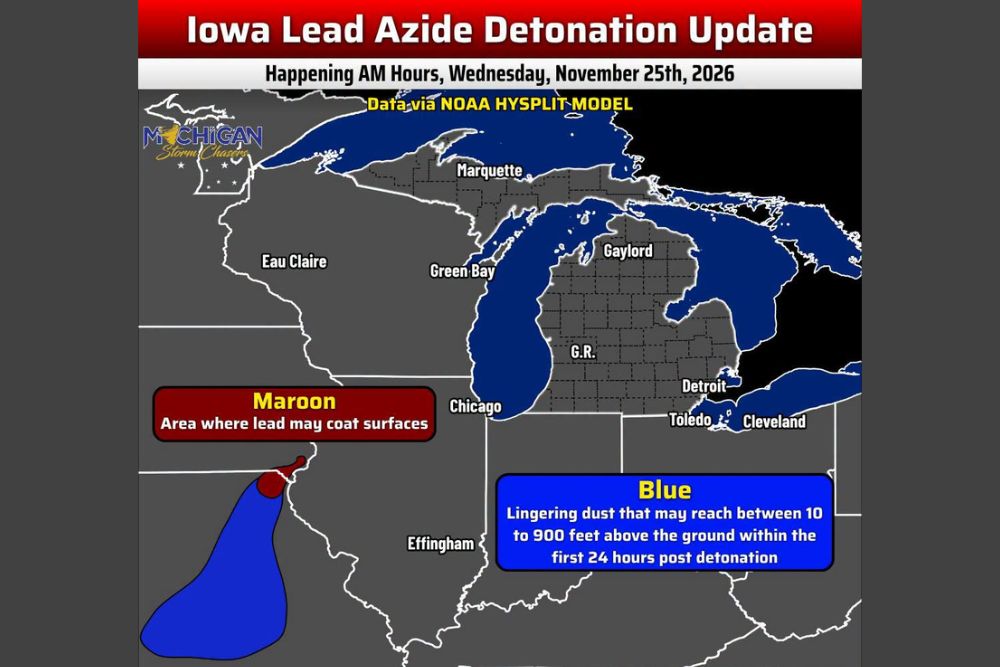
MIDDLETOWN, IOWA — The Army’s controlled detonation of lead azide at the Iowa Army Ammunition Plant is expected during the morning hours of Wednesday, November 25. New trajectory projections show that any lingering lead dust is likely to drift south-southwest toward Missouri.
What the Projection Shows
Meteorologists used the NOAA HYSPLIT model, a tool that tracks how air parcels move after a release. It shows air between 10 and 900 feet above the ground flowing south-southwest from the detonation site in southeast Iowa.
The projected path runs over the far southeast corner of Iowa and into northeast Missouri within the first 24 hours after the blast. Based on the forecast winds, Illinois communities to the east are not in the main path right now.
Where Lead Could Coat Surfaces
Forecasters marked a small zone close to the plant where higher amounts of lead could settle on soil, vehicles, buildings and playgrounds. That would happen if the plume rises more than 25 feet but stays under about 900 feet.
A wider band shows where lighter lingering dust may travel. Forecasters stress that impacts will most likely stay concentrated near the site.
Why the Dust Should Not Travel Far
Lead is far heavier than typical airborne particles, especially when it is not in a gaseous state. Heavy particles tend to fall out of the air quickly instead of riding winds for hundreds of miles.
Some social media posts compared the event to wildfire smoke spreading across the continent. Forecasters pushed back on that comparison. A wildfire burning across a hundred thousand acres is very different from 68 barrels detonated inside a contained area roughly the size of a large gymnasium, and smoke particles are much lighter than lead.
Safety Steps at the Site
Crews have been wetting the soil and using a water mist to help keep lead close to the detonation area. Residents in the Middletown City Park neighborhood have been asked to leave temporarily, and a shelter is open at the Army Reserve Center on Highway 79.
The blast was delayed twice, from Friday and then from Monday. Officials warn that degraded lead azide becomes more unstable as temperatures drop, which raises the risk of an unplanned explosion if the material is left untouched.
What Residents Should Do
People in southeast Iowa and northeast Missouri should keep windows closed, keep children and pets indoors, and avoid touching outdoor surfaces until officials give the all-clear.
After the dust settles, washing outdoor toys, wiping down porches and removing shoes at the door can help keep lead out of homes. Watch for updated plume maps from the Army and guidance from Iowa HHS and local health departments.
For continued coverage of the Iowa detonation and regional weather updates, visit northernhighlights.org.